Resident Memo is the Resident OS portal that brings reviews, alerts and owner reports into one sign-in dashboard.
Sometimes. Reviews can show a run of maintenance complaints before the issue reaches a monthly owner report, because residents post when they are frustrated, not when the report is due. They are not an early-warning system. Most residents never write a review, and the ones who do are describing something that has already happened. Read reviews as a public cross-check on maintenance, not a forecast.
This post covers why maintenance deserves that cross-check, where operators and renters disagree about it, and how a site team can read reviews for maintenance each week.
Why does maintenance matter so much to renters?
Because it shapes satisfaction and stay-or-go decisions more than most of what operators control. Buildium's 2026 survey of 1,500 U.S. renters found that maintenance has the most direct and measurable impact on renter satisfaction, perceived value and renewal decisions of all the factors it analyzed. In the same survey, 24% of renters named maintenance as their top source of stress, 25% were dissatisfied with how maintenance and repairs were completed, and 39% said better maintenance follow-through would do the most to improve their experience.
Buildium also found that the repair is only part of it. Delays without explanation, a lack of updates and having to follow up again are what erode trust.
Zillow's 2025 renter research points the same way from the other side: 68% of tenured renters said a well-maintained property was a reason they stayed at their current rental.
Do operators see maintenance the way renters do?
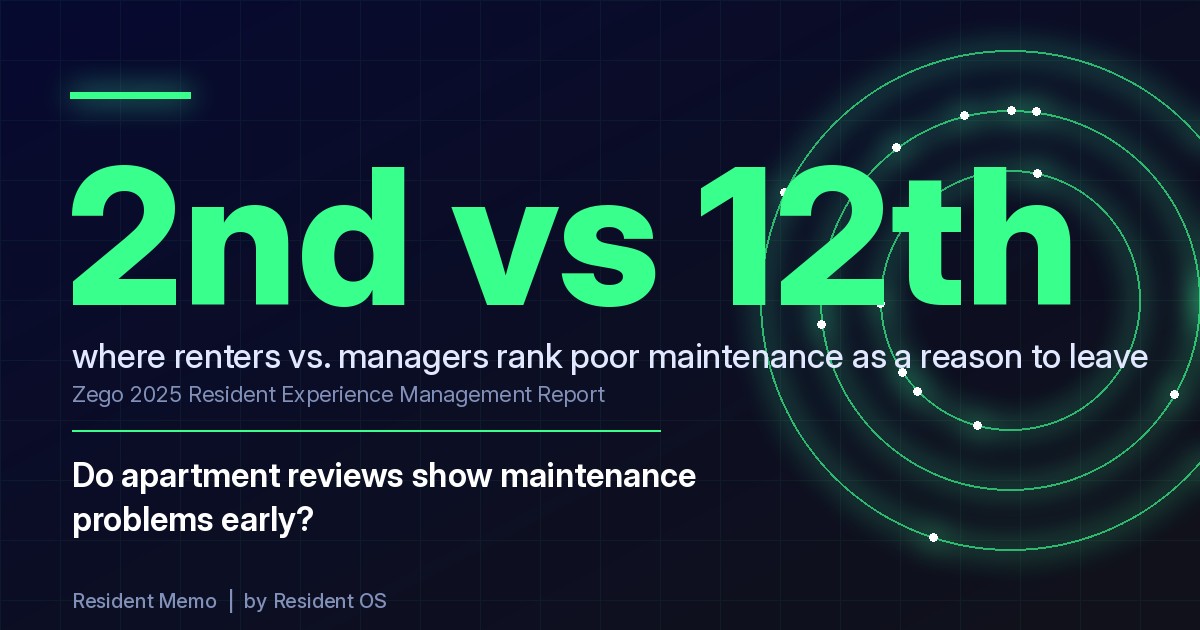
Not always. Zego surveyed 1,037 multifamily renters and 608 property managers in early 2025 and asked both groups why renters do not renew. Renters ranked poor maintenance service second, behind rent being too expensive. Property managers ranked it 12th of 17.
The same report asked what matters most in the resident experience. Maintenance repairs were among the top two choices for 44% of renters, compared with 24% of property managers asked what matters most to their renters.
When the people running a community and the people living there weigh an issue that differently, a source written by residents is a useful check. Reviews are one of the few that are public and arrive without anyone asking.
What do reviews show, and what do they miss?
They show the topics residents care about enough to write about in public, in their own words, with dates. A cluster of reviews that mention slow repairs, repeat visits or no updates is a signal worth acting on, whatever the star average says.
They miss a lot. Most residents never post. Reviews skew toward strong experiences, good and bad. They rarely say which unit, which request or which technician. And by the time a review is written, the resident has already had the bad experience. That is why we do not describe reviews as predicting anything. They are evidence of what residents report, and that evidence is sometimes visible earlier than other channels.
Operators also do not usually treat reviews this way. In an Insights by Blueprint survey of multifamily technology leaders, respondents named attracting new residents as their main goal for reputation management, and none named early detection of operational issues. Better links between reviews and maintenance work orders were among the unmet needs they listed.
How can a site team read reviews for maintenance?
A short weekly routine is enough:
- Pull every new review from every site where the community is listed, not only Google.
- Tag the maintenance ones. Note whether each is about the repair itself, the wait, or the lack of updates. Buildium's finding suggests the last two are often the real complaint.
- Count by month, not by week. One review is an anecdote. Three in a month about the same thing is a pattern.
- Check the reply. A maintenance review deserves a prompt, specific reply that offers a way to follow up offline.
- Compare with the work order log. If reviews mention slow repairs and the log shows on-time closes, find out which one is wrong.
- Report the topic, not just the score. Put the maintenance trend in the monthly owner update, with what changed.
How does Resident Memo help?
Resident Memo brings Google and other major review sites into one review inbox, with alerts when new reviews arrive. Sentiment and trends by topic, including maintenance, sit next to the ratings, so a team can see whether maintenance mentions are rising or falling over time. Owner-ready reports come already written, so the maintenance trend can go into the owner conversation without a separate spreadsheet.
Frequently asked questions
Can reviews predict maintenance problems?
No. Reviews describe what residents have already experienced and chose to post. They can surface a pattern earlier than a monthly report, but they are not a forecast.
How many maintenance reviews make a pattern?
There is no published threshold. Repeated mentions of the same issue over a few weeks are worth a closer look, and one detailed review about a safety issue is worth acting on immediately.
Should a site team reply to every maintenance review?
Yes. A specific reply shows the next prospect that someone is paying attention, and it gives the resident a way to reach the team directly.
To compare what each plan includes, see the Resident Memo plans.
Sources
- Buildium, The 2026 Renters' Report (survey of 1,500 U.S. renters, spring 2026): maintenance as the most direct driver; 24%, 25%, 39%; delays, updates and follow-ups.
- Zillow Research, Renters: Results from the Zillow Consumer Housing Trends Report 2025 (Oct 27, 2025): 68%.
- Zego, 2025 Resident Experience Management Report (PDF; 1,037 renters and 608 property managers, early 2025): second vs. 12th of 17; 44% vs. 24%.
- Insights by Blueprint, How Multifamily Operators Approach Reputation Management: Survey Results (Dec 9, 2025): reputation goals; reviews and work orders as an unmet need.