Five things: the themes residents raised this month, how those themes moved since last month, what the site team did about them, what is still open, and how all of it sits next to occupancy and renewals. An owner does not need every review. An owner needs to know whether resident experience is helping or hurting the asset, and what is being done about it.
Resident Memo is the Resident OS portal that brings reviews, alerts and owner reports into one sign-in dashboard. This post covers why owners are asking for this report now and a one-page structure that answers their questions.
Why are owners asking about resident sentiment now?
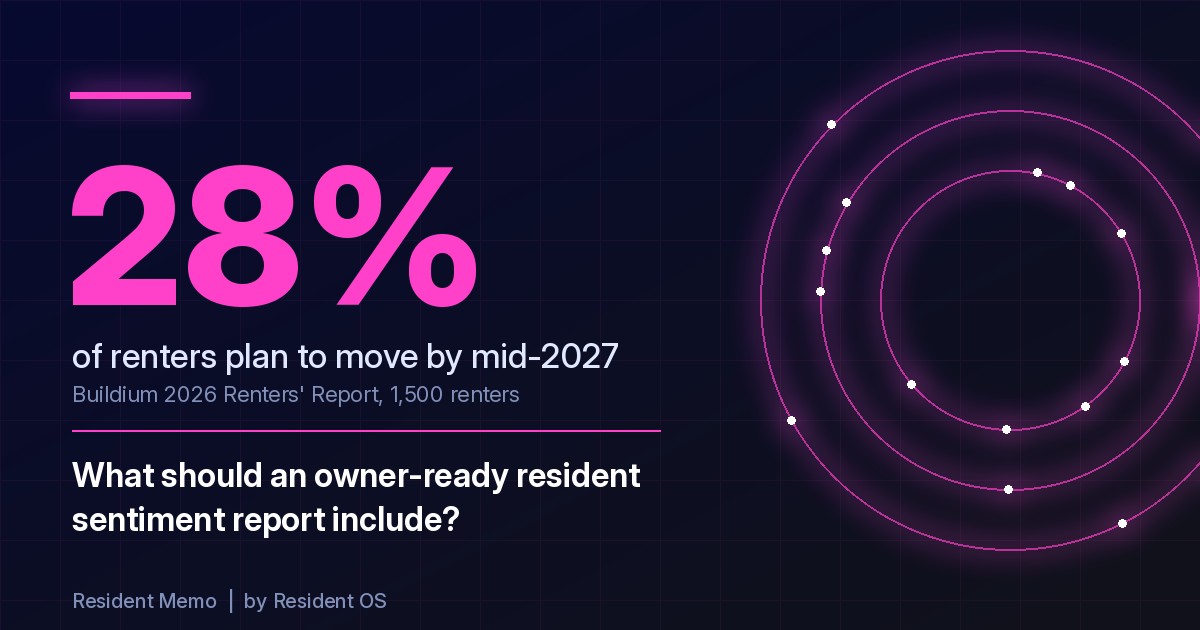
Because more residents are deciding to leave, and the window to change their minds is shrinking. Buildium's 2026 Renters' Report, a survey of 1,500 renters, found that 28% of renters plan to move between mid-2026 and mid-2027, up from 18% the year before, and only 24% remain undecided, down from 33%.
The same report ties renewals to things a site team controls. Renters who are satisfied with maintenance are 57% more likely to plan on renewing, and 39% of renters said better follow-through on maintenance requests would do the most to improve their experience. An owner reading those numbers will want to know how maintenance is landing with residents at their property.
Why can't the manager just summarize it from memory?
Because managers and residents often see the situation differently. In Zego's 2025 Resident Experience Management Report, which surveyed 608 property managers and 1,037 renters, 69% of property managers said renter expectations had increased, while only 20% of renters said their own expectations had gone up; 56% said theirs stayed the same. The same managers named understanding and anticipating resident needs as their top challenge, at 66%, and 33% listed measuring resident satisfaction as a challenge.
My read: a summary written from memory reports what the team feels. An owner report should report what residents wrote, in their own words, grouped so the pattern is obvious.
What should go on the page?
One page per community, in this order:
- Headline. One sentence on whether sentiment improved, held or slipped this month, and why.
- Top themes. The three topics residents mentioned most, such as maintenance, staff, amenities or noise, with the count of mentions and the direction since last month.
- Two or three quotes. Short, unedited lines from reviews that show the theme. In my experience, a resident's own words land with an owner in a way a paraphrase does not.
- Actions taken. What the team did on each theme, with dates.
- Open items. Negative reviews still waiting on a reply, and any issue that needs owner approval or budget.
- Next to occupancy. This month's occupancy beside the sentiment trend, so the owner can see whether a rising complaint lines up with a softening number.
Keep it to what changed. If nothing moved, say so in one line and spend the space on the open items.
What should stay out of the report?
A star average on its own, a full review dump and anything that reads like a sales pitch for the site team. Insights by Blueprint's survey of multifamily operators found that their unmet needs from reputation tools included actionable insights beyond score aggregation, linking reviews to work orders and clearer ways to quantify ROI. A score without the themes behind it is the kind of report those operators said falls short.
How does Resident Memo help?
Resident Memo builds this report from the reviews it already collects. The review inbox pulls Google and major review sites with new-review alerts, sentiment and trends are sorted by topic, and owner-ready reports come already written. Occupancy comes in as a weekly report upload from any PMS, so the sentiment trend and the occupancy number land on the same page without an integration project. Management companies can add roll-up dashboards by region, owner and portfolio.
Frequently asked questions
How often should an owner get a resident sentiment report?
My recommendation is monthly, with an extra note when a new complaint theme appears between reports.
Should the report include negative reviews?
Yes. Leaving them out is the fastest way to lose an owner's trust. Show the theme, the quote and what the team did about it.
Do I need a PMS integration to put sentiment next to occupancy?
Not in Resident Memo. A weekly occupancy report upload from any PMS is enough.
To see which Resident Memo plans include owner-ready reports, see the Resident Memo plans.
Sources
- Buildium, The 2026 Renters' Report (Aug 2026; survey of 1,500 renters): 28% plan to move (up from 18%), 24% undecided (down from 33%), 57% more likely to plan on renewing, 39% better maintenance follow-through.
- Zego, 2025 Resident Experience Management Report (Jun 2025; 608 property managers and 1,037 renters): 69%, 20%, 56%, 66%, 33%.
- Insights by Blueprint, How Multifamily Operators Approach Reputation Management: Survey Results (Dec 9, 2025): unmet needs from reputation tools.