ResidentMemo is the ResidentOS portal that brings reviews, alerts and owner reports into one sign-in dashboard.
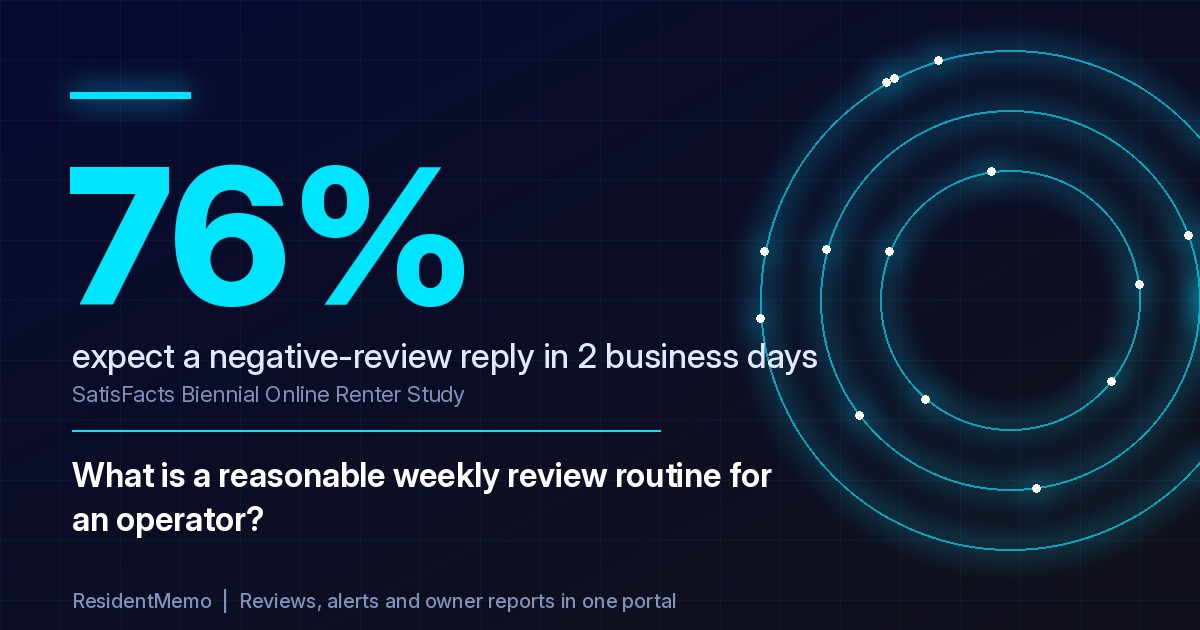
Review work expands to fill whatever time you give it, so most operators need a short weekly pass that catches what matters and leaves the rest for later. Renters notice the gap when replies are late: in SatisFacts' online renter study, 76% of renters say companies should respond to a negative review within 2 business days, and 69% say the same for a positive review. Insights by Blueprint found that roughly 70% of surveyed multifamily operators already use a reputation management platform to monitor, collect or respond to reviews, yet many teams still work reactively. This post lays out a reasonable weekly routine, what to skip, and where a portal helps.
Why a weekly pass beats an always-on scramble?
Because the public record changes every week, and renters read it before they call. SatisFacts reports that 75% of renters check out a community's online reviews before making contact, and 70% filtered for and read negative reviews during their most recent search. J Turner Research's ORA score, which evaluates ratings and review content across major sites, updates monthly, so a weekly habit gives you several chances to clean up replies and themes before the next score refresh.
My read: daily alerts are for emergencies; the weekly pass is for patterns and the reply queue. Mixing the two is how a regional manager spends an afternoon on one angry Google review and misses three communities with the same maintenance theme.
What should the weekly routine include?
Aim for one sitting per community, or one portfolio pass if you manage many sites. A practical order:
- Open new-review alerts since the last pass. Note anything that names safety, habitability or a staff member by name for a same-day call.
- Clear the reply queue. Negatives first, then positives. SatisFacts found 76% expect a negative reply within 2 business days, and 74% feel confident they can recognize a canned or automated response, so a short factual reply beats a template paragraph.
- Name one theme that showed up more than once this week (maintenance, staff, noise, packages, communication).
- Pick one action tied to that theme: a work order check, a staffing note or a follow-up with the site team.
- Scan the unanswered list older than two business days and close or escalate it.
- Save a one-line note for the owner report: what moved, what you did.
That is enough for most weeks. Expand only when a theme repeats for a second week or occupancy is also slipping.
What should you skip most weeks?
A few traps that burn time without changing the public record:
- Re-reading every five-star review in full when a skim of new ones is enough.
- Rewriting old replies that already state what was fixed.
- Chasing every review site equally. Blueprint respondents named Google Search and Google Business Profiles most often, then major listing portals such as Apartments.com and Zillow. Start there.
- Inventing a campaign every time volume is low. Asking for reviews helps; a new slogan does not clear the queue.
Blueprint also notes that most organizations remain reactive — responding to reviews — while few run proactive review-generation or sentiment programs. A weekly routine can stay mostly reactive and still be useful if replies are current and one theme gets an action.
How does this connect to scores and owners?
J Turner describes ORA as looking at ratings, feedback across 22 operational areas (including maintenance, communication and cleanliness), review volume, consistency and recency. You do not need to recite the model in the weekly meeting. You do need recent replies and fewer open negatives, because those are the inputs an operator can move. Owner-ready notes from the same sitting keep the portfolio conversation short.
How does ResidentMemo help?
ResidentMemo puts the review inbox, new-review alerts and topic trends in one sign-in dashboard, so the weekly pass is one queue instead of five browser tabs. Themes for maintenance, staff, amenities and noise are already sorted, and owner-ready reports come already written from the same material.
Frequently asked questions
How long should the weekly pass take?
It depends on review volume. For a quiet community, many operators finish in well under half an hour. For a busy portfolio, batch by region and keep the same six steps so the meeting does not sprawl.
Should every review get a reply?
We think so, especially negatives. SatisFacts reports 73% of renters feel companies do not have great customer service if they are not responding to online reviews.
Is a monthly score update enough without a weekly routine?
A monthly score tells you where you landed. A weekly routine is how you change next month's inputs.
To compare what each ResidentMemo plan includes, see the ResidentMemo plans.
Sources
- SatisFacts, 50 Renter Stats Every Multifamily Professional Needs to Know (Biennial Online Renter Study): 76%, 69%, 75%, 70%, 74%, 73%.
- Insights by Blueprint, How Multifamily Operators Approach Reputation Management: Survey Results (Dec 9, 2025): ~70% platform use; reactive vs proactive; Google and listing portals as top channels.
- J Turner Research, ORA FAQs: monthly score updates; 22 operational areas; what ORA evaluates.