ResidentMemo is the ResidentOS portal that brings reviews, alerts and owner reports into one sign-in dashboard.
Put side by side, week by week, reviews and occupancy can show which community to look at first, whether a complaint theme and a softening number are showing up in the same weeks, and whether things moved after a fix. They cannot show that one caused the other. Operators say this is the piece missing from their tools: in an Insights by Blueprint survey of multifamily operators, the greatest unmet need in reputation management was integration, including deeper connections between reputation tools and PMS systems and better linkage between reviews and operational work orders. This post covers why the pairing matters now, what it can and cannot tell you, and a simple weekly layout.
Why look at the two together now?
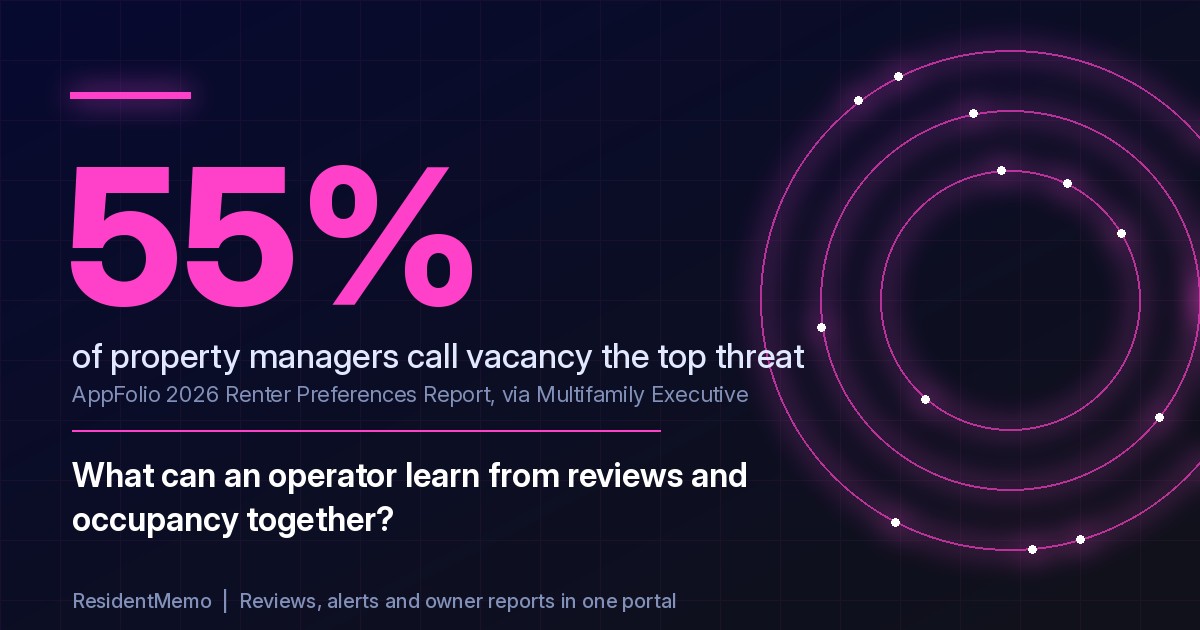
Because occupancy is under pressure and resident experience is one of the few levers a site team controls. In AppFolio's 2026 Renter Preferences Report, covered by Multifamily Executive, vacancy was the top threat for 55% of property managers, and satisfied renters were 72% more likely to renew than dissatisfied ones. On the market side, an Apartments.com article citing CoStar projections expects national vacancy to rise to 8.8% early in 2027 before easing to 8.4% by the fourth quarter.
Reviews usually sit with marketing and occupancy with operations, so the two rarely land on the same page. Blueprint found that respondents overwhelmingly cited attracting new tenants as their main goal for reputation management, with retention secondary.
What can the pairing show?
Patterns worth a conversation. My read on the useful ones:
- Where to look first. A community with rising maintenance complaints and slipping occupancy earns a call before one where only one of the two moved.
- Timing. Whether a new complaint theme started before, during or after the occupancy change. A theme that appears weeks before a dip is worth more attention than one that shows up after.
- Follow-through. After a fix, such as a new maintenance vendor or faster package handling, whether the complaint theme fades and whether occupancy and renewals hold.
- Context for owners. An owner sees one page with the sentiment trend beside the occupancy figure for the same weeks, instead of two reports from two teams.
What can it not show?
Cause. Occupancy moves for many reasons that never appear in a review: pricing, concessions, new supply nearby, the season, a large employer moving. A matching pattern is a reason to ask the site team questions.
A few other limits to keep in mind:
- Small numbers. A community with four new reviews in a month can swing on one resident. Look at several months before reading a trend.
- Lag. Unhappy residents often stay until their lease ends, so a complaint theme today may show up in renewals months later, if at all.
- Who writes reviews. Reviews come from the residents and prospects who choose to write them, so they reflect some residents and not others.
What should a weekly view include?
One row per week, per community, kept for at least three months:
- Occupancy and leased percentage from the weekly PMS report.
- New reviews that week and their average rating.
- The top one or two themes in those reviews.
- Negative reviews still waiting on a reply.
- One line on anything that changed on site: a staffing change, a repair project, a price move.
The fifth column is the one most people skip, and it often holds the explanation. When occupancy dips the same week a new competitor opened its doors, the reviews are probably not the story.
How does ResidentMemo help?
ResidentMemo puts both halves in one place without a PMS integration. A weekly occupancy or leasing report can be emailed or uploaded from Yardi, RealPage, Entrata or any PMS, and it lands next to the review inbox and topic trends for maintenance, staff, amenities and noise. Owner-ready reports come already written, so the sentiment trend and the occupancy figure for the same weeks reach the owner together. Management companies can add roll-up dashboards by region, owner and portfolio.
Frequently asked questions
Do reviews predict occupancy?
No published study we know of shows that reliably for a single community. Satisfaction is linked to renewal intent in AppFolio's survey, which is why the two are worth watching together, but a weekly view only shows patterns over time.
Do I need a PMS integration to compare the two?
Not in ResidentMemo. A weekly occupancy report emailed or uploaded from any PMS is enough.
How long before the comparison is useful?
Give it at least three months of weekly rows. Fewer than that and one unusual week can look like a trend.
To see which ResidentMemo plans include owner-ready reports and portfolio roll-ups, see the ResidentMemo plans.
Sources
- Insights by Blueprint, How Multifamily Operators Approach Reputation Management: Survey Results (Dec 9, 2025): integration as the greatest unmet need; review-to-work-order linkage; attracting new tenants as the main goal, retention secondary.
- Multifamily Executive, Satisfaction Is the New Retention Strategy (Apr 24, 2026), reporting AppFolio's 2026 Renter Preferences Report (3,002 U.S. renters): 55%, 72%.
- Multifamily Dive, It's budget season for multifamily marketers: 5 tips to get ready (sponsored by Apartments.com, Aug 24, 2026), citing CoStar projections: 8.8%, 8.4%.