Read them by theme and by age, not by star average. A portfolio manager does not have time to read every review at every community, and a single score per property hides the two things that need action: what residents keep complaining about, and which complaints are still sitting without a reply.
Resident Memo is the Resident OS portal that brings reviews, alerts and owner reports into one sign-in dashboard. This post covers what operators say they want from reputation tools, what renters expect, and a weekly routine that fits a regional schedule.
What do operators say they want from reputation tools?
One view across properties. In an Insights by Blueprint survey of its operator advisory board, published December 2025, about 70% of respondents said they use a reputation management platform, and larger operators prioritized centralized dashboards, consolidated reporting and enterprise permissioning. Smaller operators cared more about affordability and low training overhead.
The same respondents described their reputation work as mostly reactive. They named attracting new residents as the main goal and retention as secondary, and no respondent named early detection of operational issues as a goal. Their unmet needs included actionable insights beyond score aggregation and linking reviews to work orders.
My read: reviews are one of the few unfiltered reports a regional gets about how a site is running. Most teams read them only to answer them, and miss the pattern across properties.
Why isn't one score per community enough?
Scores compress. J Turner Research describes its ORA score as the industry's standardized reputation metric: a 0 to 100 score built from ratings and review content across 20+ review sites and ILSs, covering 22 operational areas, and updated monthly. J Turner's own guidance is that improving the score starts with finding which operational areas are pulling it down.
A score tells you which community to look at. It does not tell you whether the problem is maintenance response at one property or a parking change at three. For that you need the themes.
What do renters expect from the reviews and the replies?
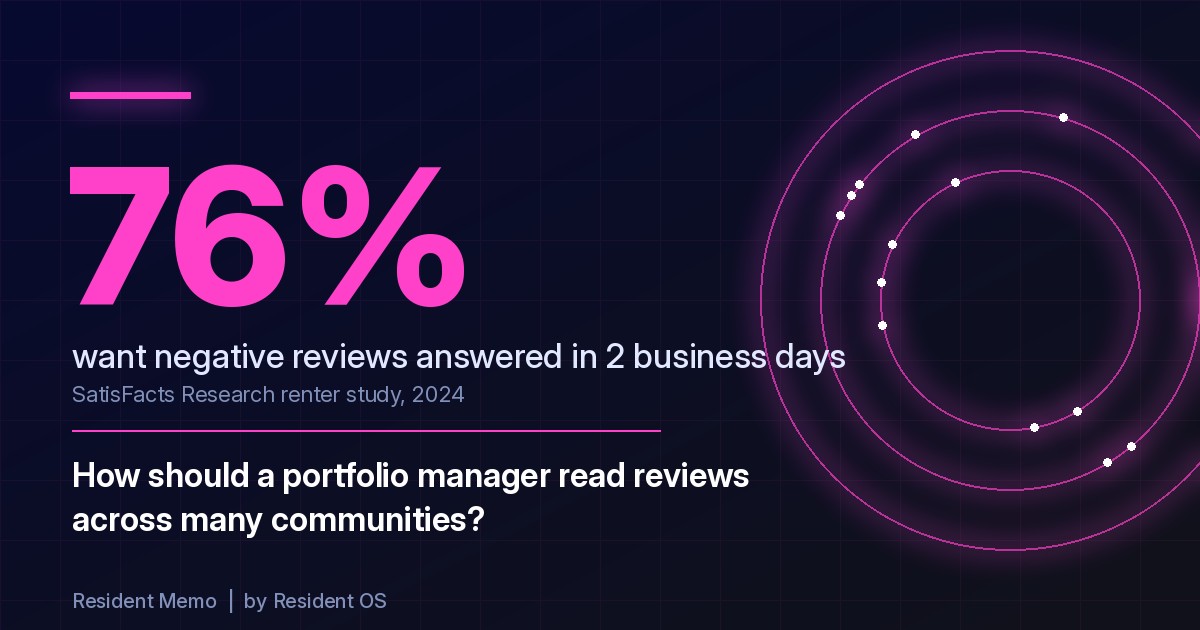
Speed and detail. SatisFacts Research's 2024 renter study found that 76% of renters say a company should respond to a negative review within two business days, and 69% say the same for a positive one. 70% filtered for and read negative reviews during their last search, and 80% said the most helpful part of a review is the detail, not the stars.
Renters are reading the same reviews your regional is. In Apartments.com's July 2026 survey of nearly 27,000 renters, 96% said reviews are important to their decision.
What should a weekly review routine look like?
Four passes, in this order:
- Open items first. List every negative review older than two business days with no reply, by community. That is the window renters say they expect.
- Themes across the portfolio. Group the week's reviews by topic: maintenance, staff, amenities, noise. A theme rising at several communities usually points to a policy or vendor, not one site team.
- Outliers. Flag any community whose themes changed from last month. A new complaint topic is an early warning; a falling star average is a late one.
- Tie it to leasing. Put the themes next to occupancy. If maintenance complaints rise where occupancy is slipping, that is the owner conversation.
Then keep the monthly owner report to what changed, what the team did about it and what is still open.
How does Resident Memo help?
Resident Memo puts the routine in one place. The review inbox pulls Google and major review sites with new-review alerts, topic trends show maintenance, staff, amenities and noise over time, and owner-ready reports come already written. Occupancy comes in as a weekly report upload from any PMS, so no integration project is needed. For management companies, the portfolio plan adds roll-up dashboards by region, owner and portfolio.
Frequently asked questions
How often should a portfolio manager review resident reviews?
Weekly for open items and themes, monthly for the owner report. Renters expect replies within two business days, so a monthly check is too slow for replies.
What should a portfolio manager look at first?
Unanswered negative reviews past two business days, then the themes that repeat across communities.
Do I need a PMS integration to compare reviews with occupancy?
Not in Resident Memo. A weekly occupancy report upload from any PMS is enough.
To compare what Resident Memo includes for a single community and for a portfolio, see the Resident Memo plans.
Sources
- Insights by Blueprint, How Multifamily Operators Approach Reputation Management: Survey Results (Dec 9, 2025): about 70% use a reputation platform; dashboard, reporting and permissioning priorities; reactive approach; goals; unmet needs.
- J Turner Research, ORA FAQs: 0-100 score, 20+ review sites and ILSs, 22 operational areas, monthly updates.
- SatisFacts Research, 50 Renter Stats Every Multifamily Professional Needs to Know (Jan 10, 2024): 76%, 69%, 70%, 80%.
- Apartments.com, How Renters Decide: Top Considerations in 2026 (Jul 14, 2026): nearly 27,000 renters; 96%.