Resident Intelligence is the practice of connecting reputation, marketing, and leasing signals to explain why apartment communities win or lose leases. HeyNeighborly delivers it, powered by its ResidentOS platform.
Our view: run one brand voice and one set of builder accounts, then give each community its own website page, its own ad sets and a fair share of the content calendar based on what it needs to sell this month. Buyers decide on the builder as much as on the house, so the brand is where trust builds. The community is where the specific reasons to visit live.
HeyNeighborly works with single-family builders as well as apartment communities, and this is one of the first questions builders ask us. This post covers what recent buyer surveys say, how to divide the work between brand and community, and a way to decide what each community gets each month.
Why does the builder brand matter so much to a new-home buyer?
Because the buyer is judging the company that will build the house, often before the house exists. In a September 2026 Homes.com study of more than 3,000 adults buying or budgeting for a new home, 54% considered builder experience and 57% considered the quality of materials when choosing a builder, compared with 30% who considered financial incentives. The same release says objective reviews carried more weight than social media.
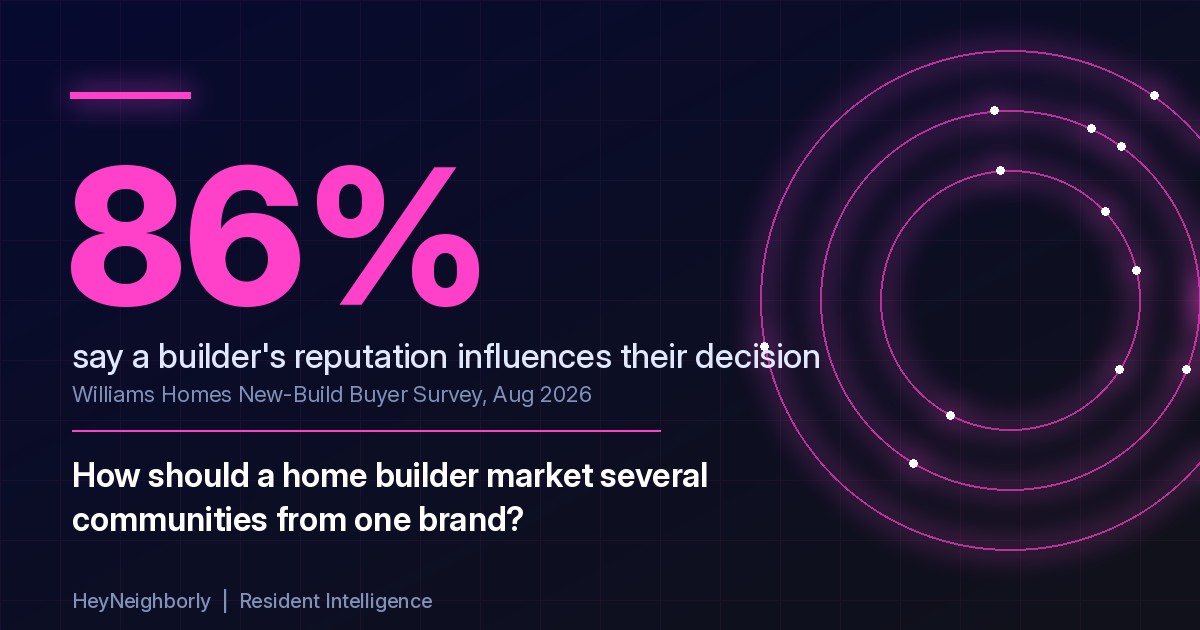
A smaller August 2026 survey of 1,011 Americans, run by the builder Williams Homes, found that 86% say a builder's reputation influences their decision to buy a new-build home, and 76% say they would choose a highly reputable builder even if it cost more. Treat it as one builder's survey of the general public, not of active buyers.
The practical point for marketing: reviews, Google Business Profile replies and the builder's own social accounts are seen by buyers for every community at once. A slow reply to a warranty complaint at one community is part of the pitch at the others.
Should each community get its own social accounts?
Usually not. Separate accounts split a small following, need their own posting schedule and tend to go quiet once a community sells out. A builder account that posts about each community in turn keeps one audience growing and keeps the brand consistent.
New Home Star, a new-home sales firm, gives similar advice for Facebook: create one builder profile, use regional pages rather than community pages where you need local reach, and avoid too many geographic pages, since regional pages outlast any single community's closeout.
There are exceptions. A master-planned community with its own amenity center, events and resident life can earn its own page because people keep living there and posting about it.
What should stay at the community level?
The things a buyer needs to picture one specific place:
- A community page on the builder's website with current homes, floor plans, the site plan, pricing ranges where the builder publishes them, and directions to the model.
- Separate ad sets for each community inside shared campaigns, so spend can move toward the community that needs sales and away from one that is nearly sold.
- Video and photos shot at that community. In the Homes.com study, videos of homes and communities were the most popular virtual search tool at 42%, ahead of interactive floor plans at 36% and interactive site plans at 29%.
- Local detail. The same study found buyer priorities varied widely across the 10 states it looked at, so a feature that sells in one market may not lead the copy in another.
How do you decide what each community gets this month?
Start from the sales calendar. Ask the sales team three questions each month: which community has the most homes to sell, which has news worth showing (a model opening, a new phase, homes ready to move into) and which is close to selling out. Then weight the month:
- The community with the most inventory or the biggest news gets the largest share of posts and ad spend.
- Communities with steady sales get regular coverage so they do not disappear from the feed.
- A nearly sold-out community gets a final push, then its content shifts to resident stories that help the brand.
This is a judgment call, and the split will change. What matters is that someone decides it on purpose each month instead of letting the community that sends the most photos get the most posts.
How does AI search change this?
It raises the stakes on consistent, accurate information. In the Homes.com study, 51% of respondents used AI tools during their home search. An AI answer about a builder pulls from reviews, listings, the website and anything else it finds. If community pages are out of date or review replies are missing, that is what gets summarized. Keeping each community page current and replying to reviews at the brand level helps both search and AI answers.
Frequently asked questions
Can one person run social for a builder with several communities?
Yes, if the content comes in reliably from each community. The posting is the easy part. The usual bottleneck is getting fresh photos, video and updates from each site.
Should a builder reply to reviews from the corporate account or the community?
From the builder's own profile for that location, in one consistent voice, with a named contact for follow-up. Buyers read the replies to judge how the builder handles problems after closing.
Do new-home ads need separate budgets for each community?
Separate ad sets with their own budgets make it easier to see which community is producing leads and to move money between them as sales change.
If you are a builder weighing how to run marketing across several communities, book a call with HeyNeighborly.
Sources
- Homes.com via CoStar Group, New-Construction Buyers Prioritize Space, Financial Confidence and Function, Homes.com Survey Finds (Sep 10, 2026): 54%, 57%, 30%; reviews vs. social media; 42%, 36%, 29%; 51%; 10-state variation.
- Williams Homes, New-Build Buyer Survey: What Americans Want in a New Construction Home (Sep 17, 2026; survey fielded August 2026, 1,011 respondents): 86%, 76%.
- New Home Star, The Importance of Facebook Marketing in New Home Sales (updated Aug 14, 2026): one builder profile, regional pages.