ResidentMemo is the ResidentOS portal that brings reviews, alerts and owner reports into one sign-in dashboard.
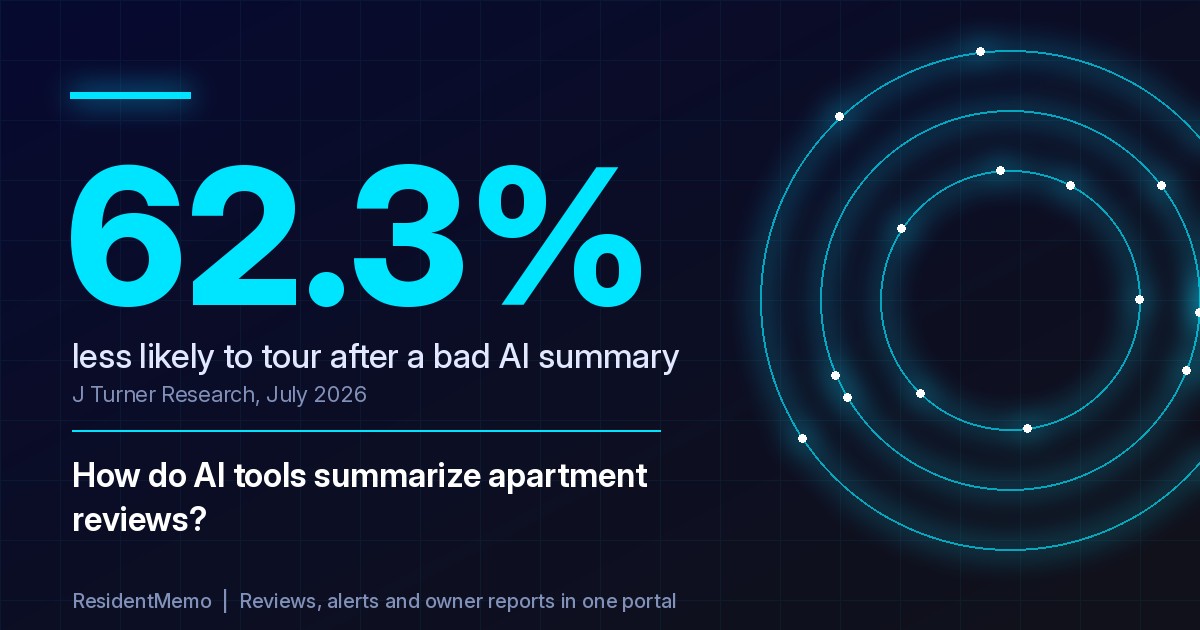
Asked about a community, an AI tool such as ChatGPT condenses what residents have written into a few sentences of praise and complaint. J Turner Research calls this a new layer of review interpretation, and renters act on it. In the same July 2026 report, 45.9% of renters said they now use AI tools for apartment searching or review analysis, and 62.3% said they were less likely to tour a property after an unfavorable AI-generated summary. This post covers what renters ask AI to do, why the review text matters more than the star average in a summary, and what an operator can check in an hour.
What are renters asking AI tools to do?
Mostly shortlisting and comparing. Among renters who use AI in their search, J Turner found the top uses were generating lists of apartments that meet their requirements (42.3%), comparing communities side by side (40.0%) and researching neighborhoods and safety (36.6%). The same post splits the 45.9% into 19.8% who said AI was integral to their search and 26.1% who used it as an occasional extra tool.
Few renters start there. J Turner's Internet Adventure Study VI reports that 5.7% began their most recent search with an AI tool before visiting a listing site or Google. My read: AI is usually a step in the middle of the search, where a renter narrows a list, and that is where a summary of a community's reviews gets read.
Why does the review text matter more than the star rating?
Because a summary is built from what reviewers wrote. J Turner describes the effect in both directions: a high star rating can be undercut by a critical summary, and a fair rating can be lifted by a favorable one. In its reverse case, a 4.3-star property with a favorable summary, 67.3% of renters said they would be more likely to tour.
Renters were already reading this way before AI. In SatisFacts' online renter study, 80% of renters said the most helpful part of a review is the detailed information, not the stars, and 70% filtered for and read negative reviews during their most recent search. An AI summary now does some of that reading for them.
Insights by Blueprint makes a similar point about search: modern search algorithms and AI-driven search engines evaluate far more than average scores, including review volume, velocity, sentiment and responsiveness.
What goes into a summary of one community?
Nobody outside the AI companies can say exactly which reviews a given tool reads or how it weighs them, and the answer changes between tools. What an operator can see is the raw material: the public reviews on Google and the major review sites, and the replies under them. A few practical consequences follow from that, and they are my interpretation rather than a published rule:
- Repeated themes carry. One mention of a broken gate is noise. The same complaint in six reviews over two months is likely to show up as a pattern.
- Recent reviews count. If the last three months read differently from the last three years, a summary may reflect either, depending on the tool.
- Replies are part of the record. A reply that says what was fixed and when gives a reader, human or AI, a second side of the story.
What can an operator check in an hour?
Pick one community and run this:
- Ask two AI tools a renter-style question, such as "What do residents say about living at" followed by the community's name. Save the answers with the date.
- Read the last 20 public reviews and list the three themes that come up most.
- Compare the two. If the AI answer leads with a theme the site team considers fixed, find the reviews it is drawing on and check whether they have a reply that says so.
- Count the negative reviews without a reply. Those are the easiest gap to close.
- Repeat the AI questions next month and see whether the answers moved.
Treat the AI answer as a reading of the public reviews. To move it, the reviews and replies have to change: the issue gets fixed, the reply says so, and satisfied residents are asked to write about their experience.
How does ResidentMemo help?
ResidentMemo puts the raw material in one place. The review inbox pulls Google and major review sites with new-review alerts, and topic trends show how maintenance, staff, amenities and noise move over time. That is the same text an AI summary draws from, sorted so an operator can see which theme is growing before it becomes the first line of a renter's answer. Owner-ready reports come already written.
Frequently asked questions
Can an operator change what an AI tool says about a community?
Not directly. The tools summarize public information, so the lasting fix is in the reviews and replies themselves: resolve the repeated issue and reply with what was done.
How many renters use AI to look at apartments?
J Turner Research reports 45.9% use AI tools for apartment searching or review analysis, and 5.7% started their most recent search with one. Other surveys report different figures because they ask the question differently.
Does a higher star rating protect a community from a bad summary?
Not according to J Turner, which reports that a critical summary can undercut a high rating. The text of the reviews is what gets summarized.
To compare what each ResidentMemo plan includes, see the ResidentMemo plans.
Sources
- J Turner Research, LLMs Are Influencing the Apartment Search Journey (Jul 21, 2026): 45.9%, 19.8%, 26.1%, 42.3%, 40.0%, 36.6%, 62.3%, 67.3%.
- J Turner Research, The Internet Adventure Study, Part VI: 45.9%, 5.7%.
- SatisFacts, 50 Renter Stats Every Multifamily Professional Needs to Know (Biennial Online Renter Study, Jan 10, 2024): 80%, 70%.
- Insights by Blueprint, How Multifamily Operators Approach Reputation Management: Survey Results (Dec 9, 2025): what search and AI engines evaluate.